

Research project purpose and objective:
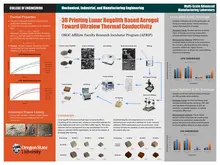
The development of lightweight, thermally insulating materials is critical for sustaining long-term operations on the lunar surface. This study focuses on the fabrication and characterization of Nanocellulose aerogels derived from Lunar Regolith Simulant (LRS), utilizing freeze casting to achieve low thermal conductivity. Samples were prepared with varying weight percentages (wt%) of Lunar Highlands Simulant (LHS) and Lunar Mare Simulant (LMS) through Direct Ink Writing (DIW) additive manufacturing techniques.
Method:
Post-fabrication, the samples were subjected to two distinct drying methods—air drying and freeze casting/freeze drying—to evaluate their effects on volumetric shrinkage. The dried aerogels were then sintered at 1100 Co to enhance structural stability and mechanical performance. Shrinkage was measured using water displacement, and thermal conductance was visualized using thermal imaging techniques.
Key result or argument:
Shrinkage analysis revealed significant differences between air-dried and freeze-dried samples, with freeze drying effectively preserving the pore structure and minimizing deformation. Thermal conductivity tests demonstrated the promise of LRS aerogels as highly efficient insulators, essential for addressing the extreme temperature variations on the lunar surface. Furthermore, the comparative analysis of LHS and LMS samples highlighted how compositional differences had a minor influence on both shrinkage behavior and thermal properties.
Conclusion:
This research provides a systematic approach to optimizing the processing and material characteristics of regolith-based aerogels, expanding the foundation for their application in extraterrestrial habitats and thermal management systems. The findings contribute to advancing additive manufacturing technologies for space exploration and addressing critical challenges in lunar material development.