

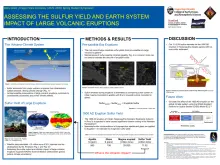
Sulfur emissions from large volcanic eruptions can significantly alter the global climate. Since few large volcanic eruptions have been observed during the instrumental era, quantifying the atmospheric sulfur loading from past eruptions remains a challenge. This study focused on the 1600 AD eruption of Volcán Huaynaputina, which erupted approximately 13-14 km³ of dacite magma and is suspected to have caused significant climate cooling in the Northern Hemisphere.
Page 17 of 20 2025 Spring Symposium Proceedings
To determine how sulfur was transferred from the subsurface to the atmosphere during this large-scale eruption, we applied mineral and glass chemistry to thermodynamic models to establish the pre-eruptive conditions and estimate the sulfur output. Using apatite, a mineral phase that incorporates sulfur into its crystal structure, we determined the sulfur content of the Huaynaputina magma. The sulfur content in volcanic glass from pumice was used to quantify the amount of sulfur retained in the erupted products. Electron microprobe analyses of apatite and volcanic glass yield sulfur concentrations of approximately 563 ppm and 138 ppm, respectively.
We calculate a sulfur yield of 11.02 Mt when scaling to the amount of erupted material. Applying these sulfur estimates to the NASA Goddard Institute for Space Studies E2.2 climate model will enable a detailed reconstruction of the atmospheric and climatic impact of the eruption, providing insights into the extent of cooling effects on the Northern Hemisphere.
Interdisciplinary studies that apply petrologic data to atmospheric models are necessary for improving our understanding of the volcano-climate system throughout the Earth’s history.