

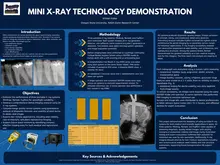
As space missions extend in duration and distance, astronauts face increasing limitations in accessing traditional medical diagnostics. To address this, NASA’s Medical Capabilities Office, in collaboration with Johnson Space Center and Glenn Research Center, evaluated portable x-ray systems optimized for low mass, volume, and power consumption—critical constraints aboard the ISS and future off-world habitats. A 2023 market survey narrowed 200 candidates to three systems: Remedi REMEX-KA6, MinXray Impact Wireless, and Fujifilm FDR Xair.
This project assessed imaging performance and usability to support down-selection. I developed a dental imaging protocol in collaboration with Cuyahoga Community College’s Dental Hygiene program to evaluate diagnostic radiograph quality and ease of use for novice operators. Quantitative image analysis compared clarity, exposure parameters, and workflow efficiency.
Additionally, I designed a non-destructive plant imaging protocol with input from NASA Kennedy Space Center to evaluate each system’s ability to visualize root architecture, vascular flow, reproductive structures, and seed viability. Skeletal phantom imaging was performed at Tri-C’s Western Campus to simulate clinical scenarios.
Preliminary results show all three systems are viable for spaceflight, and image quality, software integration, and operational simplicity are being used to evaluate the three systems. This research supports NASA’s goal of enhancing autonomous medical diagnostics and biological imaging in space, contributing to resilient healthcare and life sciences infrastructure for long-duration missions.