

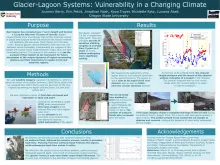
Glaciers that flow into lakes behave differently than those that flow into the ocean because the salinity of the water controls melt water buoyancy that drives circulation at the terminus. Between these two end members, “lagoon-terminating glacier” systems exist with temporally variable water properties with salinity in between freshwater and sea water. These systems are understudied, yet potentially increasing in importance as the margins of ice sheets and ice fields retreat with warming climate. Bear Glacier within the Kenai Fjords National Park, Alaska, is a fast-evolving glacier system that fits this category: glacial lake outburst floods drive changes in salinity through erosion of the moraine (barrier that separates the lagoon from the ocean). While previous accounts state that Bear Glacier terminates in a freshwater lake, here we present new data and satellite imagery that show how Bear Glacier evolved from a marine-terminating glacier to a lake-terminating glacier to its present state as a lagoon-terminating glacier in approximately 70 years. Specifically, we describe the evolution of Bear Glacier Lagoon since its formation in the 1950s due to glacial retreat. We also present one dynamic process that varies the salinity in time: an outburst flood, followed by moraine erosion, results in sea water backflow during high tide or storms that increases salinity. The combined effects have shown to amplify the glacier’s retreat. Ultimately, we provide a framework for future discussions of the unique dynamics of lagoon-terminating glaciers and their importance for coastal Arctic and subarctic regions.