

As light travels from our Sun to Earth, it interacts with forces that cause the light to become polarized; from the magnetic fields of space dust, to the scattering of our own atmosphere, the polarization caused by these interactions must be accounted for when observing properties of our sun. The polarization of most of our sun’s light has been well documented over the years (Nagendra & Stenflo, 1998); however, the sun’s corona is particularly difficult to observe under normal conditions, due to its relatively low brightness. During events such as a solar eclipse, we can more directly observe the sun’s corona, and more easily measure properties like polarization.
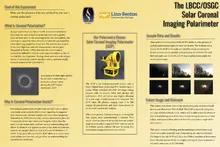
The SCIP is an Arduino-powered camera with a Bower digital linear polarizing filter hooked up to a motor. When activated, the SCIP will begin taking pictures with its camera. After each picture, the polarization filter will rotate one degree, allowing for a new angle of polarization to be observed. The SCIP takes 181 photos, ranging from 0 to 180 degrees of polarization, and saves these photos to an SD card stored in the Arduino. This entire process, from powering on to saving the final photo, takes approximately 3 minutes. This would allow an observer to quickly find the correct angle of polarization using the SCIP, and the use of an Arduino greatly reduces the cost of taking this observation compared to existing methods.