

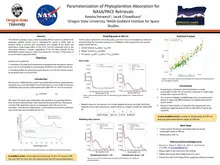
The Plankton, Aerosol, Cloud, ocean Ecosystem (PACE) mission is a NASA Earth-observing satellite mission that is scheduled for launch in 2024, with its purpose being to monitor the composition and changes in the ocean and atmosphere using images taken of the Earth from the ultraviolet (UV) to the short-wave infrared. A proper exploitation of the UV data collected by the NASA/PACE sensors requires models that relate the “UV color” of the ocean to the particulates suspended within. The objectives of this project are to develop such models by (i) extending from the visible into the UV a heritage parameterization of phytoplankton absorption spectra (aph) in terms of Chlorophyll-a concentration [Chl]; and (ii) including profiles for anomalous peaks in aph that occur in the UV and that cannot be parameterized in terms of [Chl]. Using previous methods that extended the heritage [Chl]-based parameterization of aph from 400 nm to 350 nm, the approach for objective (i) is to further extend the [Chl]-based parameterization of aph down to 300 nm by utilizing in-situ datasets that include aph values in the 300-350 nm range. The approach for objective (ii) is to isolate the anomalous peaks of aph in these datasets by subtracting the UV-extended [Chl]-based parameterization of aph, and by fitting the resulting isolated aph peaks with absorption line profiles. The PACE mission marks the first time that NASA will take space-borne images in the UV to study changes in the plankton population, paving the way for new opportunities to study how our oceans are changing on a global scale. Extending the heritage [Chl]-based parameterization of aph into the UV, and combining it with absorption profiles for aph peaks in the UV, constitutes a crucial step towards taking advantage of these new measurement capabilities that PACE is offering.