

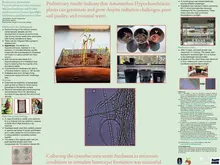
Dysfunction of the immune system, cardiovascular disease, and the development of cancer are some of the high priority human health risks regarding the human exploration of Mars (Patel et al.). To some degree, these health risks can be mitigated with a properly adapted diet (Kyriacou, 2017). For this project, we started testing the hypothesis that selective breeding of the seeds of Amaranthus Hypochondriacus, previously exposed to x-ray radiation, in simulated Martian regolith will result in a viable nutrient-rich food source, available from both its seeds and leafy biomass. If adapted to extraterrestrial conditions for growth, this plant could serve as a healthy food source during space travel and exploration of the Martian surface. A. Hypochondriacus seeds, prior to being planted in simulated Martian regolith, will be challenged with X-rays before germination and in regular times thereafter until leafy biomass and grain have been produced. To assist growth in Martian regolith, we will use nitrogen-fixing cyanobacteria (Singh). In regular periods, plant growth and plant nutritional value will be determined by weighing plant mass and measuring nitrogen, carbohydrate, and crude fat content. Nitrogen content will serve as a measure for crude protein content. We expect that A. Hypochondriacus plants cultured under these conditions will show increased growth and provide higher nutrient value compared to unirradiated plants. This project will yield knowledge on the feasibility that nutrient-rich A. Hypochondriacus can be adapted to grow in extraterrestrial conditions. Achieving such a food source represents a major milestone in the human exploration of Mars.