

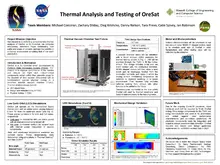
OreSat is a 2U CubeSat under development at Portland State Aerospace Society (PSAS). Our mission was to provide PSAS with a full thermal analysis of the current OreSat design and make actionable suggestions to ensure all flight- and mission-critical components remain within their operable range through the duration of the mission. Thermal analysis is broken into two stages: orbital heat transfer computer simulation and physical testing in a thermal vacuum chamber. Thermal simulations revealed that the batteries would likely experience concerningly low temperatures, while heat-generating components such as CPU’s would stay within an operable range. The battery assembly was redesigned, and heaters were added. For testing, a liquid nitrogen radiative cooling system was designed to be placed into a vacuum chamber to simulate low-Earth orbit conditions. Due to covid-19 restriction, only limited access to the vacuum chamber has been granted and testing was postponed. As a result, our team pivoted to focus more on design and simulations. Thermal simulations and FEA were performed on the test equipment to ensure smooth operation once the system could be built. The completed cryogenic cooling system will be delivered to PSAS, and limited testing will take place by the end of 2020.