

Image

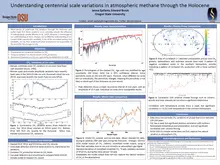
Atmospheric methane (CH4) is an important greenhouse gas, responsible for a large part of the Earth’s radiative budget. Understanding how atmospheric CH4changes is important to understand future climate. While large, millennial scale changes in CH4have been extensively studied, only recent measurements of CH4have been high enough resolution to resolve centennial and multidecadal scale changes. High resolution CH4 records from three Antarctic ice cores spanning the Holocene period (11,700 ka), were analyzed to understand their characteristics, and then compared against climate proxies to identify possible drivers of CH4changes. The NASA GISS-E2 climate model was also investigated to understand if the model predicts the CH4data observed in ice cores. Characterization of the CH4 record shows some periodicity in the 80 to 200-year range, though the results are not likely significant. Atmospheric CH4 shows a weak, but significant positive correlation with northern hemisphere temperature. Correlation with precipitation shows a significant positive relationship in the northern hemisphere, and a weak but significant negative correlation in the southern hemisphere, indicating a possible relationship with the movement of the ITCZ. Characterization of the CH4 output of the NASA GISS-E2 climate model shows different variations in CH4than observed in ice cores, indicating the possibility for future improvement in atmospheric CH4modeling, and important part of fully understanding future climate.