

Image

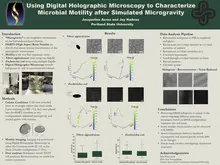
The weightless environment on the International Space Station exposes organisms to unique conditions, in some cases causing changes to gene expression or phenotype. Changes to motility can influence pathogenicity in many organisms. However, since conducting experiments on the Space Station is difficult, devices have been designed to mimic certain aspects of the microgravity environment including low fluid shear and lack of sedimentation.For this study, we used two test organisms:Vibrio alginolyticus and Uropathogenic Escherichia coli. These were chosen for their distinctive motility patterns of run-reverse-flick and run-and-tumble, respectively. We placed cells into high aspect ratio vessels (HARVs). Following exposure to simulated microgravity, we imaged them using digital holographic microscopy (DHM). DHM is a label-free technique that allows imaging of cells in unconstrained volumes. DHM produces holograms that record XYZT information. There is currently no standard for processing DHM holograms and techniques remain unique to the dataset of interest. In this work, we discuss different processing and tracking methods for our datasets, highlighting strengths and shortcomings of each. From these, we developed a method to generate 3D tracks and identify key motility characteristics including motility patterns and quantification of speeds. We show that there did not appear to be a quantifiable difference in motility when considering the uncertainties involved. Our future work will investigate the impact of simulated microgravity on chemotaxis, the ability of cells to sense and change directions based on a chemical concentration gradient.